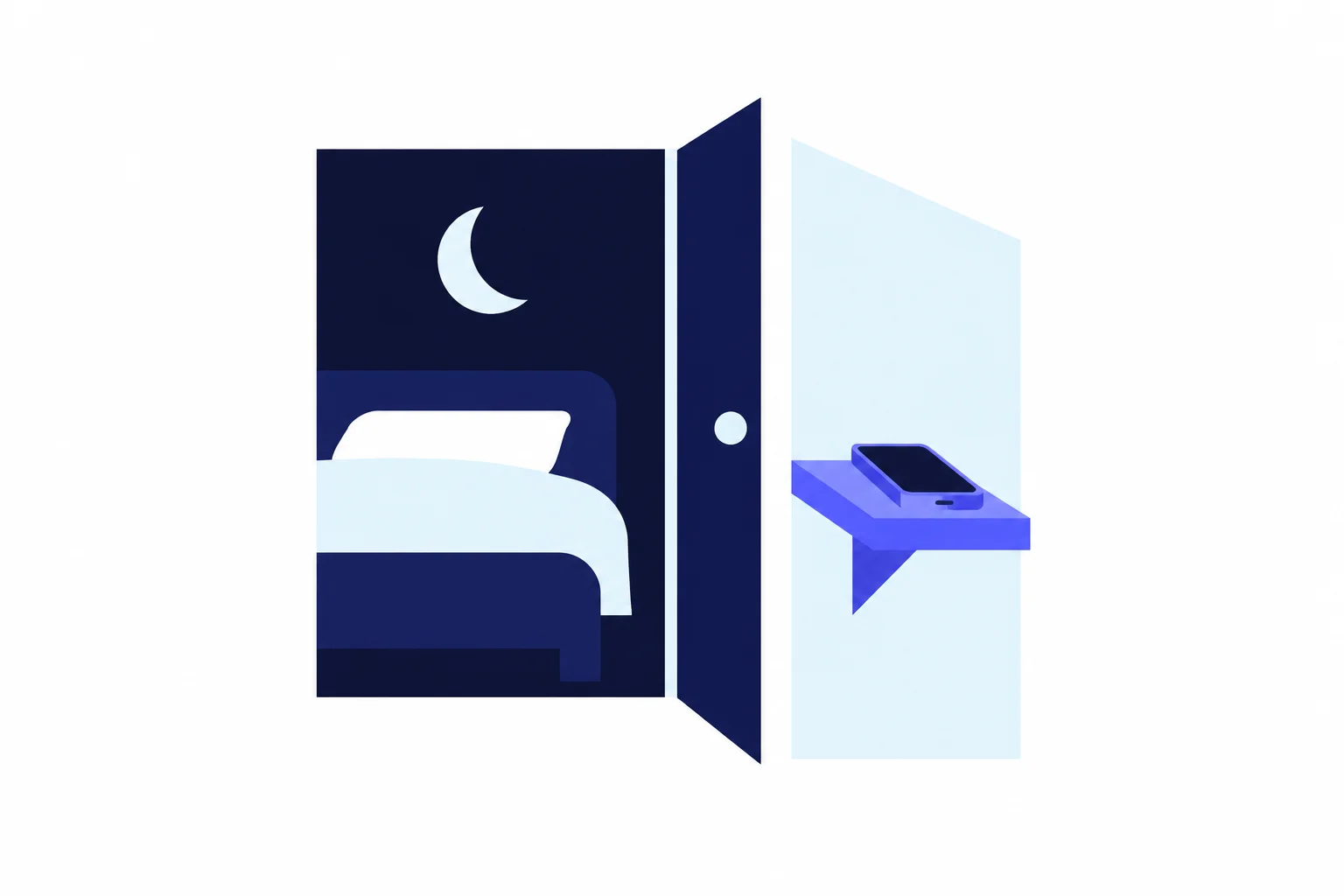
Two US medical groups issued fresh bedtime-screen advice early in 2026. On January 20, the American Academy of Pediatrics (AAP) told families to avoid screens in the hour before bed and keep devices out of bedrooms; on February 23, the American Academy of Sleep Medicine (AASM) urged adults to power down 30 to 60 minutes before bed and leave phones in another room. Recent studies point more to screen time after getting into bed than to the color of the light, so moving the phone away from the pillow is better supported than switching on a night filter.
Key takeaways
- In an AASM-commissioned survey of 2,007 US adults, 50% said they use a screen in bed every day.
- In a lab study, 12 young adults took about 10 minutes longer to fall asleep after four hours of reading on an iPad than after a printed book.
- A 2021 trial in 167 young adults found no sleep difference between iPhone use with Night Shift on, with it off, or no phone in the hour before bed.
- In 45,202 Norwegian students, each extra hour of screen use after going to bed was linked to 59% higher odds of insomnia symptoms and 24 minutes less sleep; a survey link, not proof of cause.
What it means for you
- Adults who scroll in bed: the AASM's 2026 advice is to stop 30 to 60 minutes before bed and charge the phone in another room. Adult studies link it to minutes of lost sleep, plus more insomnia symptoms with in-bed use.
- Teens: an expert panel agreed in 2024 that screen use, and what is watched before sleep, impair sleep in children and adolescents. A camera study of New Zealand teens found that screen use once in bed, rather than in the two hours before, was tied to shorter sleep.
- Parents of young children: the AAP advises no screens in the hour before bed and no devices in the bedroom, and suggests quiet music, sound machines or meditation apps for children who fall asleep to videos.
- People who read e-books at night: the lab study that found delayed sleep tested a backlit tablet in a very dim room; it did not test e-ink readers or a few minutes of reading.
- People with insomnia: the AASM advises getting out of bed after about 20 minutes awake and avoiding electronics while up. Insomnia on three or more nights a week for three months or longer is chronic insomnia, which has its own treatment.
- Shift workers: none of the screen studies here tested daytime sleep, so their figures may not carry over; the AASM has separate shift-work guidance, linked in the plan below.
What the 2026 advice says
Current guidance from US professional bodies, with dates:
| Source | Date | What it advises about screens and sleep |
|---|---|---|
| AASM survey release on bedtime "doomscrolling" | February 23, 2026 | Power down electronics at least 30 to 60 minutes before bed; put phones in another room and use a clock for the alarm; silence notifications if the phone stays in the room; aim for at least seven hours of sleep |
| AAP policy statement "Digital Ecosystems, Children, and Adolescents" | Released January 20, 2026 (Pediatrics, February 2026 issue) | Avoid screen exposure an hour before bedtime and devices in the bedroom; enable nighttime "do not disturb"; make bedrooms and the hour before bed phone-free zones for the whole family |
| AASM healthy sleep habits | Updated August 2020 | Turn off electronic devices at least 30 minutes before bedtime; limit bright light in the evening; use the bed only for sleep and sex |
The AAP statement, announced in a January 2026 news release, replaces the academy's earlier media guidance and shifts focus toward how engagement-driven apps are designed, but its bedtime advice stays concrete.
The AASM figures come from a commissioned online survey by a market research firm (fieldwork June 2025, margin of error ±2 points). Beyond the daily 50%, another 33% use a screen in bed most days or several days a week, so 83% do so at least several times a week. And 38% said reading news on a phone or tablet before bed makes their sleep worse, rising to 46% among 18- to 24-year-olds.
Light or engagement: the evidence
Much bedtime advice centers on blue light, which can suppress melatonin, the evening hormone that helps signal it is time to sleep; the AASM's 2026 release still mentions it. The effect is real in the lab; newer research asks how much it matters at ordinary doses compared with what people do on the screen.
The tablet-versus-book lab study
In the Brigham and Women's Hospital study by Chang and colleagues (PNAS, online December 2014), 12 healthy young adults spent 14 days in a hospital unit. On five evenings they read on an iPad set to maximum brightness for about four hours before a fixed 10 p.m. bedtime in a very dim room; on five others they read printed books.
Time to fall asleep:   25.65 min (iPad) vs 15.75 min (print) → 9.9 min longer
REM sleep:             109.04 min vs 120.86 min → 11.8 min less
Melatonin onset next day: 22:31 vs 21:01 → 90 min later
Evening melatonin during reading: suppressed about 55% (iPad); no suppression (print)
Light at the eye:      31.73 lux (iPad) vs 0.91 lux (print page)
Lux measures how much light reaches the eye; the tablet delivered roughly 35 times more than the page in that dim room. Total sleep time did not differ in the fixed eight-hour sleep periods. Four hours on a bright tablet in a dark room is also a heavier dose than a short session before lights out.
Night Shift did not change sleep
A randomized trial by Duraccio and colleagues (Sleep Health, 2021) assigned 167 college students aged 18 to 24 to use an iPhone with Night Shift on, use it with Night Shift off, or not use a phone in the hour before bed, for seven nights. Wrist-worn sensors found no significant difference in sleep among the three groups. In an exploratory analysis of students who averaged more than 6.8 hours of sleep, those who skipped the phone had the best sleep efficiency.
Where the expert panel landed
A 16-member National Sleep Foundation consensus panel (Sleep Health, 2024) reviewed 522 empirical studies and agreed that screen use and pre-sleep content impair sleep in children and adolescents, and that behavioral strategies may reduce the harm. According to the University of Colorado Boulder's summary, the panel did not reach consensus that screen light before bed impairs sleep for anyone, or that screen time, light or content affects adults' sleep. On light, the lead author said the current data are not strong enough to say conclusively that it has a direct effect, which is not the same as proof that it has none.
A 2026 study in the Journal of Sleep Research adds one more piece: among 70 New Zealand children aged 11 to 14, heart rate during evening screen use was lower than during other activities (median 83 vs 93 beats per minute). The authors concluded that the link between screens and sleep runs mainly through later sleep timing rather than physical arousal.
Why screens in bed matter most
Teens tracked on camera
In the Dunedin study by Brosnan and colleagues (JAMA Pediatrics, September 2024), cameras recorded screen use and wrist sensors measured sleep for 79 children aged 11 to 14 over 323 nights. Screen time in the two hours before bed was not associated with most sleep measures. Once in bed, each extra 10 minutes on a screen was linked to 3 minutes less sleep and sleep starting 7 minutes later; for interactive use such as messaging or gaming, the figure was 9 minutes less sleep per 10 minutes. The authors wrote that advice to restrict all screen time before bed seems "neither achievable nor appropriate."
A 2026 meta-analysis in JAMA Pediatrics pooled 25 studies of 4,562 young people aged 3 to 25 that compared each person's heavier and lighter screen days. Heavier days came with a small shift to later sleep onset, but no significant change in total sleep, time to fall asleep or overall sleep quality; screen use after bedtime had the strongest link to worse sleep quality.
Adults and in-bed use
The Norwegian student survey by Hjetland and colleagues (Frontiers in Psychiatry, March 31, 2025) asked 45,202 people aged 18 to 28 about screen use after going to bed. Each extra hour was associated with 59% higher odds of insomnia symptoms and 24 minutes less sleep. In a US study of 122,058 adults from an American Cancer Society cohort, published in JAMA Network Open in March 2025, daily use of a phone, tablet or laptop in the hour before sleep was linked to a 33% higher prevalence of poor sleep quality than no use, bedtimes about 19 minutes later and 7.6 minutes less sleep on workdays. Both are one-time surveys, so people who already sleep poorly may simply reach for the phone more.
Illustrative example: what the per-minute figures add up to
Illustrative example, using the published averages and assuming they scale in a straight line, which the studies did not test:
Teen, 30 min of in-bed screen use (Brosnan, per 10 min):
  all screen use:    30 ÷ 10 × 3 min = about 9 min less sleep
  interactive use:   30 ÷ 10 × 9 min = about 27 min less sleep
                     (study range 2 to 16 min per 10 min: 6 to 48 min)
Adult, daily pre-sleep screen use vs none (Zhong, per workday):
  7.64 min × 5 workdays = about 38 min less sleep per work week
The result: a half hour of messaging or gaming in bed lines up with roughly a half hour less sleep for a teen, though the true figure could be far smaller or larger. Adults who used a screen daily in the hour before sleep reported about 7.6 minutes less sleep on workdays than non-users (5 minutes on free days). For adults, the bigger signal is poorer sleep quality and insomnia symptoms. These are associations, not measured effects of cutting back.
This information is educational and does not replace advice from a clinician who knows your health history.
Frequently asked questions
Does social media hurt sleep more than other apps?
Not in the Norwegian student survey: the links between in-bed screen time and insomnia symptoms or shorter sleep did not differ between social media and other activities. In the 2026 New Zealand heart-rate study, social media close to bedtime was linked to a heart rate about 3 beats per minute lower than other screen activities, while messaging was linked to about 3 beats higher.
Is it fine to use my phone as an alarm?
The AASM's 2026 advice is to put the phone in another room at bedtime and use a standard clock for the alarm. If the phone does stay in the bedroom, the AASM suggests silencing notifications, and the AAP recommends nighttime "do not disturb" settings for children and teens.
Does a phone on the nightstand matter if it stays on silent?
In a 2016 meta-analysis of 20 studies of 125,198 children aged 6 to 19, those who had access to a device at night but did not use it were more likely to report too little sleep (odds ratio 1.79) and daytime sleepiness. The AAP's 2026 technical report adds that alerts, ringers and notifications can arrive at any stage of sleep and may disrupt it. These were one-time surveys of young people, so they may not apply directly to adults.
What should I do if I wake at 3 a.m. and can't fall back asleep?
The AASM's general tip is that if you don't fall asleep after about 20 minutes, get out of bed and do a quiet activity with little light. It says it is especially important not to get on electronics during that time. Return to bed when you feel sleepy. If this happens three or more nights a week, see the insomnia step in the plan below.
Is watching TV or videos in bed less of a problem than texting?
In the Dunedin camera study, passive in-bed screen use such as watching videos was linked to about 4 minutes less sleep per 10 minutes, compared with about 9 minutes for interactive use, and the passive estimate was borderline (its range ran from 7 minutes less to no difference). A 2015 review of 67 studies found screen time, including TV, linked to shorter or later sleep in 90% of studies of school-aged children and teens.
A screen plan for tonight
- Set a power-down time 30 to 60 minutes before you want to be asleep, with a phone reminder that fires before it, not at bedtime.
- Charge the phone outside the bedroom and use a basic alarm clock. If it has to stay in the room, put it out of reach and turn on "do not disturb."
- If you do use a screen in bed, keep it short. In the camera study, messaging and gaming had the largest link to lost sleep. Watching or reading was linked to less lost sleep, and that estimate was borderline, so it does not show passive use is harmless.
- Replace the habit, not just the device: a printed book, journaling, a warm shower or quiet music are the kinds of wind-down activities the AASM and AAP suggest.
- For children: make bedrooms and the hour before bed screen-free for the whole family, since the AAP frames this as a family rule, and charge devices outside bedrooms overnight.
- Know when it is more than habit. Under the AASM's definition, trouble sleeping at least three nights a week for at least three months is chronic insomnia, and cognitive behavioral therapy for insomnia (CBT-I) is the recommended treatment for adults. Loud snoring with breathing pauses, choking or gasping, or ongoing daytime sleepiness or fatigue, can signal sleep apnea; either pattern is worth raising with a doctor or a sleep center. Shift workers sleeping by day can use the AASM's shift-work guidance.
Sources
- American Academy of Sleep Medicine: Americans are "doomscrolling" at bedtime (February 23, 2026)
- Munzer T et al. Digital Ecosystems, Children, and Adolescents: Policy Statement. Pediatrics, 2026
- Munzer T et al. Digital Ecosystems, Children, and Adolescents: Technical Report. Pediatrics, 2026
- American Academy of Pediatrics news release (January 20, 2026)
- AASM Sleep Education: Healthy sleep habits
- Chang AM et al. Evening use of light-emitting eReaders negatively affects sleep, circadian timing, and next-morning alertness. PNAS, 2015
- Duraccio KM et al. Does iPhone Night Shift mitigate negative effects of smartphone use on sleep outcomes in emerging adults? Sleep Health, 2021
- Hartstein LE et al. The impact of screen use on sleep health across the lifespan: A National Sleep Foundation consensus statement. Sleep Health, 2024
- CU Boulder Today: Light or content? What we know about screens and sleep disruption (May 28, 2024)
- Meredith-Jones KA et al. Screens, Teens, and Sleep: physiological arousal study. Journal of Sleep Research, 2026
- Brosnan B et al. Screen use at bedtime and sleep duration and quality among youths. JAMA Pediatrics, 2024
- Bourke M et al. Within-person association between daily screen use and sleep in youth: a systematic review and meta-analysis. JAMA Pediatrics, 2026
- Hjetland GJ et al. How and when screens are used: comparing different screen activities and sleep in Norwegian university students. Frontiers in Psychiatry, 2025
- Zhong C et al. Electronic screen use and sleep duration and timing in adults. JAMA Network Open, 2025
- Carter B et al. Association between portable screen-based media device access or use and sleep outcomes. JAMA Pediatrics, 2016
- Hale L, Guan S. Screen time and sleep among school-aged children and adolescents: a systematic literature review. Sleep Medicine Reviews, 2015
- AASM Sleep Education: Insomnia
- AASM Sleep Education: Obstructive sleep apnea
- AASM Sleep Education: Shift work disorder