The 2025 AHA/ACC high blood pressure guideline, published online August 14, 2025, calls home monitoring, combined with frequent contact with a care team, an important tool for improving blood pressure control, and lists the home readings that correspond to office cutoffs. So a home average can feed into diagnosis and medication decisions, but only if it is accurate. The three biggest levers are a validated upper-arm monitor, a cuff that fits your arm, and a standard schedule of paired readings that you average rather than eyeball.
Key takeaways
- The American Heart Association recommends an automatic, cuff-style upper-arm monitor and says wrist and finger monitors give less reliable readings.
- In a 195-person trial, a regular cuff read on average 4.8 mm Hg (systolic) too high on people who needed a large cuff and 19.5 mm Hg too high on those who needed an extra-large one.
- A common protocol is 2 readings at least 1 minute apart, morning and evening, ideally for 7 days and at least 3 days, averaged.
- In the 2025 guideline's table, a home average of 130/80 corresponds to an office 130/80, and 135/85 at home to 140/90 in the office.
- A reading higher than 180 and/or 120 mm Hg with symptoms such as chest pain or trouble speaking means calling 911; without symptoms, retest after a minute and call your clinician if it stays that high.
What it means for you
- Just told to monitor at home: Get a validated upper-arm device, follow the routine below, and have it checked at your next appointment.
- High readings only at the doctor's office: Home readings or a 24-hour monitor are how clinicians check for white-coat hypertension.
- Large or small arms: A wrong cuff can shift readings by several mm Hg, and by about 20 for very large arms.
- Older adults: Choose a device validated for seniors, and do not change or stop medication based on home numbers alone.
- Pregnant: Use a monitor validated for pregnancy; the guideline's 180/120 severe-hypertension definition applies to people who are not pregnant, so ask your clinician which readings need a call.
- Buying a monitor now: Check the validated device listing, measure your upper arm, and skip cuffless smartwatch-style devices.
Home numbers vs office numbers
The 2025 guideline was published in Hypertension and copublished in Circulation and the Journal of the American College of Cardiology. The AHA's readings chart lists the categories: normal below 120 and below 80; elevated 120 to 129 and below 80; stage 1 hypertension 130 to 139 or 80 to 89; stage 2 hypertension 140 or higher or 90 or higher.
Home averages run slightly lower at the upper end. The guideline's Table 7 gives these corresponding values:
| Office reading (mm Hg) | Corresponding home average (mm Hg) |
|---|---|
| 120/80 | 120/80 |
| 130/80 | 130/80 |
| 140/90 | 135/85 |
| 160/100 | 145/90 |
The guideline says to interpret these with caution, because the data come mainly from European, Australian and Asian populations and observational studies. Only a doctor or other medical professional can confirm a diagnosis.
The AHA and AMA joint policy statement on self-measured blood pressure (Circulation, 2020) says blood pressure can differ considerably in and out of the office. Home readings help identify white-coat hypertension (high in the office, not outside it) and masked hypertension (the reverse).
The stakes are wide: the CDC reports that 48.1% of US adults (119.9 million) have high blood pressure and 22.5% of them (27.0 million) have it under control, based on NHANES 2017 to March 2020 data.
Choosing the right cuff and device
Upper arm, validated, correct size
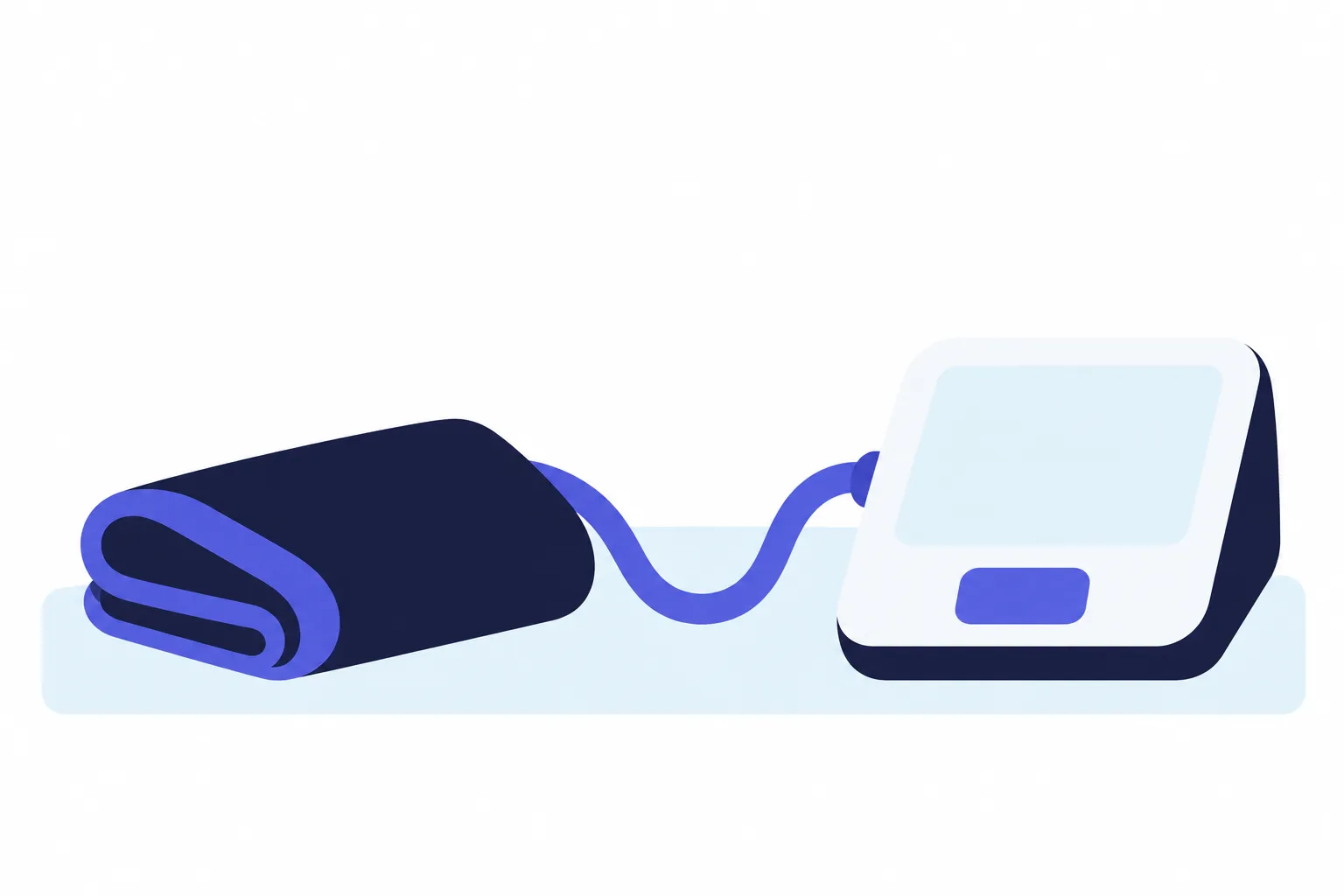
The AHA's home-monitoring page recommends an automatic, cuff-style upper-arm monitor, says wrist and finger monitors are not recommended because they give less reliable readings, and tells buyers to choose a validated model. For sizing, measure around your upper arm and pick a monitor that comes with the matching cuff. The AHA/AMA statement adds that wrist devices can help people whose arms do not fit the available upper-arm cuffs.
Validation means a device was tested for accuracy against a reference standard using a standardized protocol. The 2025 guideline points to the US Blood Pressure Validated Device Listing, which the AMA describes as a free resource. In an AMA article (July 30, 2025), cardiologist Eugene Yang says only about 20% of US home devices are validated. If you are buying for a senior, a pregnant person or a child, the AHA says to confirm the model is validated for that group.
What a wrong cuff does to the number
A randomized crossover trial (Ishigami et al., JAMA Internal Medicine, 2023) measured 195 adults with a wide range of arm sizes using an automated device and different cuffs. Average systolic difference, regular cuff vs the appropriate one:
| Cuff the person needed | Regular cuff vs appropriate cuff (systolic) | 95% CI |
|---|---|---|
| Small | 3.6 mm Hg lower | 1.7 to 5.6 lower |
| Large | 4.8 mm Hg higher | 3.0 to 6.6 higher |
| Extra-large | 19.5 mm Hg higher | 16.1 to 22.9 higher |
A 4.8 mm Hg error moves a true 126 to about 131, across the 130 line. A 19.5 mm Hg error moves a true 125 to about 145, past the home equivalent of stage 2 (135). The AHA/AMA statement adds, from NHANES 2007 to 2010 data, that 52% of men and 38% of women with hypertension need a cuff size other than a standard adult cuff.
Taking a reading and averaging
Preparation and position
The AHA lists these steps: no smoking, caffeinated drinks or exercise within 30 minutes; empty your bladder; bare the arm; rest quietly at least five minutes; do not talk or use the phone. The AHA/AMA statement adds back and arm supported, legs uncrossed, feet flat. The cuff sits at heart level, its bottom edge directly above the bend of the elbow. Either arm is fine, the AHA says; measure at the same time each day.
Schedule and the average
The statement's common protocol: 2 measurements at least 1 minute apart, morning and evening, optimally for 7 days (28 readings), with a minimum of 3 days (12 readings). Average all the readings and avoid the "eyeball method" of scanning the numbers. Some guidelines also recommend excluding the first day's readings; if you do, the preferred and minimum periods become 8 and 4 days.
Illustrative example (invented numbers): 4 days of 4 readings, with day 1 dropped.
| Day | Four readings (systolic/diastolic) | Used in average? |
|---|---|---|
| 1 | 142/88, 140/86, 138/86, 136/84 | No (first day) |
| 2 | 134/84, 132/82, 136/84, 130/82 | Yes |
| 3 | 130/80, 132/82, 128/80, 130/82 | Yes |
| 4 | 134/84, 130/82, 132/82, 128/80 | Yes |
average = sum of readings / number of readings
days 2-4: systolic 1,576 / 12 = 131.3; diastolic 984 / 12 = 82.0
all 16:   systolic 2,132 / 16 = 133.3; diastolic 1,328 / 16 = 83.0
day 1:    systolic 556 / 4 = 139.0;    diastolic 344 / 4 = 86.0
Dropping day 1 lowers the average from about 133/83 to 131/82. Both sit between the home values 130/80 and 135/85, the range matching office stage 1, so the category does not change in this example. Day 1 alone (139/86) is above 135/85, the home equivalent of office stage 2, which is why one day should not be used on its own. Only a clinician can make a diagnosis.
When a reading needs action
The AHA says a single high reading is not an immediate cause for alarm: take a second one and check with your healthcare professional. Its 2025 chart has two categories for readings higher than 180 and/or higher than 120 mm Hg:
- Hypertensive emergency: with chest pain, shortness of breath, back pain, numbness, weakness, a change in vision or difficulty speaking, call 911.
- Severe hypertension: without those symptoms, wait 1 minute and test again; if it is still that high, contact your healthcare professional immediately.
What Medicare covers
An archived CDC page on health insurance coverage (coverage as of November 2016) says Original Medicare Part B does not cover home blood pressure monitors for self-measurement, and the 2020 AHA/AMA statement says they are excluded from the equipment Part B covers. Medicare Advantage plans are not required to cover them but may, so check your plan's current benefits. For home dialysis, the CMS benefit policy manual counts blood pressure equipment among supplies paid through the dialysis facility.
Medicare's National Coverage Determination 20.19 does cover ambulatory blood pressure monitoring, a 24-hour monitor, once per year for suspected white-coat or masked hypertension. It requires average office readings in set ranges on two visits plus at least two out-of-office readings: below 130/80 for suspected white-coat, 130/80 or higher for suspected masked hypertension.
On the clinic side, the AMA's coding guide describes CPT 99473 (training on a validated device, once per device) and 99474 (collecting and interpreting at least 12 readings, once per calendar month). The guide does not address payer coverage, so ask your practice. The 2020 statement says FSA and HSA funds can pay for a home monitor; confirm with your plan administrator.
Frequently asked questions
Can a smartwatch or ring replace a cuff?
No. The 2025 guideline says to avoid relying on cuffless devices, including smartwatches, until they show greater precision and reliability; the AMA notes most have had no regulatory evaluation.
Can two people share one monitor?
Only if the device stores readings for more than one person, says the AHA/AMA statement; otherwise averages get mixed.
Should I bring my monitor to the doctor?
Yes. The AHA suggests bringing it to check your technique against office equipment, then once a year, or as the manufacturer directs, to confirm accuracy.
Does the week-long routine go on forever?
Not indefinitely. The AHA/AMA statement says that once control is reached and stays stable for several months, monitoring 1 to 3 days every week is probably sufficient.
Can I change my medication based on home readings?
No. The AHA says home monitoring does not replace doctor visits and not to stop blood pressure medication without checking with your healthcare professional.
Checklist for your first week
- Look up the monitor model on the validated device listing before you buy, and measure your upper arm for the matching cuff size.
- Each session: five minutes of quiet rest, back and arm supported, feet flat, bare arm, no talking.
- Take 2 readings at least 1 minute apart, morning and evening, and write each down or use a monitor with memory.
- Average all the readings (ask whether to drop day 1), compare with the home column above, and share the average.
- Know your plan for a reading higher than 180 and/or 120 mm Hg: 911 with symptoms; otherwise retest after a minute and call your clinician if it stays high.
This article is educational and is not medical advice. Targets and treatment depend on your health history, so discuss your readings with a licensed clinician.
Sources
- 2025 AHA/ACC guideline for high blood pressure in adults, Hypertension (Table 7)
- AHA, Understanding Blood Pressure Readings
- AHA, Home Blood Pressure Monitoring
- AHA/AMA joint policy statement, Self-Measured Blood Pressure Monitoring at Home (Circulation, 2020)
- Ishigami et al., Cuff(SZ) trial, JAMA Internal Medicine, 2023 (PubMed)
- US Blood Pressure Validated Device Listing
- AMA, Don't trade your BP device for cuffless technology just yet (July 30, 2025)
- CDC, High Blood Pressure Facts
- CDC (archived), Current Health Insurance Coverage
- CMS, Medicare Benefit Policy Manual, Chapter 11 (ESRD)
- CMS, NCD 20.19 Ambulatory Blood Pressure Monitoring
- AMA, SMBP coding quick guide