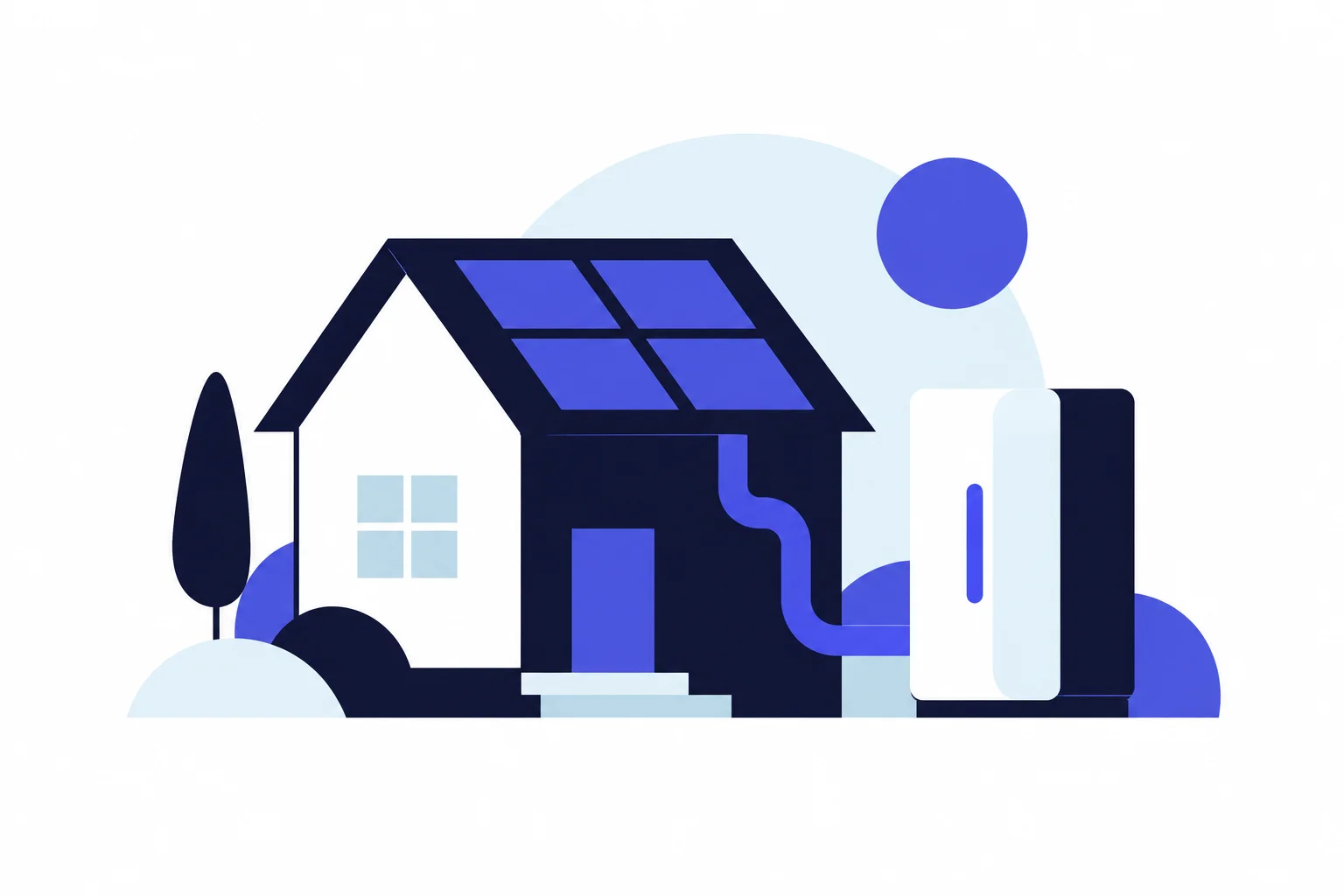
Berkeley Lab's solar data update, published in August 2026, found that 37% of new home solar systems installed in 2025 came with a battery, up from 25% in 2024, and an industry report released September 22, 2026 put the rate at 46% for the second quarter of 2026, according to the American Public Power Association's summary. For a household shopping for solar, a battery quote is now standard in several states. Whether it pays depends on how your utility credits exported power and whether a program pays you to share the battery. Homeowners who own their system, whether paid in cash or with a loan, also lost the 30% federal credit for installations completed after 2025.
Key takeaways
- Battery attachment to new home solar rose from 25% in 2024 to 37% in 2025, per Berkeley Lab: California went from 58% to 74%, all other states combined from 7% to 17%. Hawaii and California lead; Arizona and Texas jumped.
- "Catching on" describes a rising share, not booming volume: an industry forecast expects home storage installations to shrink about 4% in 2026.
- For cash buyers, Berkeley Lab's 2025 median price was $5.1 per watt of solar for solar plus a battery versus $3.0 for solar alone, a $2.1 per watt premium.
- A battery pays best where exports earn little and evening power costs a lot, as under California net billing, or where a utility program pays for it. Where exports are credited one-for-one at a flat rate, daily cycling loses a little money; under time-of-use net metering it earns only the peak-to-off-peak gap, minus losses.
What it means for you
Find your situation; details follow below.
- You already have solar: if your utility credits exports at a flat full retail price, a battery mainly buys backup and possible program payments, not bill savings; on a time-of-use plan, savings are limited to the gap between peak and off-peak prices (see the worked example).
- You are buying solar now: expect a battery in the quote. Owned systems completed after 2025 get no federal credit, whether bought with cash or a loan, so the battery premium is paid in full unless a state or utility incentive applies.
- You are a Californian under net billing: midday exports earn far less than evening power costs, which is why 74% of new systems had a battery. The worked example runs the numbers.
- You live in an outage-prone area: backup is a real benefit; check whether a utility program could drain the battery before storms (see the FAQ).
- You rent or own a condo: a battery is a permanent electrical installation, so renters need the landlord's permission, and condo owners should check HOA rules first.
- You were offered a lease or power purchase agreement (PPA): the company, not you, claims any federal credit, and batteries keep theirs longer than panels do (see "Tax credits after 2025").
What the 2025 and 2026 data show
The Berkeley Lab 2026 data update covers roughly 5.3 million systems, including about 450,000 installed in 2025, which the lab estimates is 93% of the US market. An attachment rate is the share of new solar systems installed together with a battery. Berkeley Lab notes that it does not count batteries added later to existing solar or stand-alone batteries.
| Market (home systems) | 2023 | 2024 | 2025 |
|---|---|---|---|
| United States | Not compared here | 25% | 37% |
| California | 14% | 58% (57% in the 2025 edition) | 74% |
| All other states combined | 5% | 7% (8% in the 2025 edition) | 17% |
The 2023 figures come from the Berkeley Lab 2025 data update; the lab revises earlier years slightly. In the 2026 state chart (read from unlabeled bars), Hawaii is near 87%, Arizona around 60% and Texas around 50%; most other states sit at roughly 25% or less.
A rising share is not the same as rising sales: the share also climbs when solar-only sales fall faster. Quarterly industry data, which use different methods and are not government statistics, point to flat or falling volumes in 2026:
- The American Clean Power Association and Wood Mackenzie's US Energy Storage Monitor, released September 22, 2026, counted 676 MW of home batteries in Q2 2026, down 15% from Q1 and up 3% year over year, per the American Public Power Association's summary. The same summary reports attachment at 46%, up from 41% in Q2 2025, and a forecast 4% decline for 2026, then about 9% annual growth through 2031.
- The Solar Energy Industries Association and Benchmark Mineral Intelligence put Q2 2026 home storage at 657 MWh, down 27% from a year earlier, which they linked to the rush to install before the homeowner credit ended, as reported by ESS News.
Batteries got more powerful but not bigger: the 2025 median held 13.5 kWh, as in 2024, while median discharge power rose from 6 kW to 11.4 kW, which Berkeley Lab ties to the Tesla Powerwall 3. More power runs more appliances at once; it does not add hours of backup.
Why California flipped to batteries
Since April 15, 2023, PG&E, SCE and SDG&E customers applying to connect solar have taken service on the net billing tariff instead of net energy metering, according to the California Public Utilities Commission. Under net billing, exported power is credited at a rate that reflects its value to the grid, not at the retail price. SCE explains that its export prices come from the CPUC's Avoided Cost Calculator, vary by hour and month, and are fixed for nine years from the date a customer's system starts operating.
PG&E's residential rate sheet effective March 1, 2026 lists its Electric Home (E-ELEC) plan at 55 cents per kWh from 4 to 9 p.m. in summer and 32 cents in winter. A 2026 UC Davis graduate study that modeled a PG&E customer with 2025 export prices put the average net billing export credit at under 9 cents per kWh, though it also found that credits in August peak hours (5 to 10 p.m.) ran about ten times the average for the rest of the year. A battery that stores midday surplus for the evening captures that gap, and California's attachment rate went from 14% in 2023 to 74% in 2025. The same study found PPAs rose from under 20% of interconnections under the old rules to over 45% under net billing.
Low-income households may qualify for the Self-Generation Incentive Program's $280 million Residential Solar and Storage Equity budget, open for reservations since June 2, 2025; additional eligibility criteria apply, and the CPUC directs applicants to the program site for its current status.
Tax credits after 2025
Public Law 119-21, signed July 4, 2025, ended the residential clean energy credit (Section 25D) for expenditures made after December 31, 2025. The IRS FAQ on the change says an expenditure counts as made when installation is completed, so paying in 2025 for a system finished in 2026 does not qualify. The cutoff applied to cash and loan buyers alike, because both own the system.
With leases and PPAs, the owner company claims a business credit under Section 48E. For solar panels, that credit ends for systems placed in service after December 31, 2027, unless construction began by July 4, 2026, as IRS Notice 2025-42 explains.
Storage is exempt from that cutoff. Its credit stays at the full rate for projects that begin construction through 2033, then drops to 75% in 2034, 50% in 2035 and zero after that. Storage that began construction after 2025 is excluded if it involves "material assistance" from a prohibited foreign entity. In plain terms, a company-owned battery can carry a federal credit after company-owned panels lose theirs. The phase-down years come from the 2032 "applicable year" in Section 45Y. The credit goes to the company; whether any of it reaches your price depends on the contract.
Third-party ownership made up 40% of new home solar in 2025, up from 23% in 2023, Berkeley Lab found, and lower-income adopters used it more.
This section is general information, not tax advice; a tax professional can confirm how the rules apply to a specific installation date or contract.
A worked bill-savings example
A battery's bill value comes from one swap: surplus that would have been exported is stored and used instead of grid power.
Daily value = (kWh stored × round-trip efficiency × evening import price)
            − (kWh stored × export credit given up)

Simple payback (years) = battery cost ÷ annual value
kWh stored is midday surplus kept instead of exported; round-trip efficiency is the share that comes back out; the evening import price is what grid power would have cost; the export credit is what the utility would have paid.
Illustrative example, California net billing. Assumptions, all rounded: a PG&E customer on E-ELEC; the battery stores 10 kWh a day in summer (June to September, 122 days) and 6 kWh in the other 243 days; 90% round-trip efficiency; an export credit of 8 cents per kWh; evening prices of 55 cents in summer and 32 cents in winter; and a battery premium of $12,600, based on Berkeley Lab's $2.1 per watt cash-price premium applied to a 6 kW solar system. The 6 kW size is close to the 6.03 kW median for net billing systems in the UC Davis study, which itself modeled a 12 kWh battery at $12,000. These are assumptions, not quotes; your installer's prices and your household's surplus will differ.
- Summer day: 10 × 0.9 × $0.55 − 10 × $0.08 = $4.95 − $0.80 = $4.15
- Winter day: 6 × 0.9 × $0.32 − 6 × $0.08 = $1.73 − $0.48 = $1.25
- Year: 122 × $4.15 + 243 × $1.25 ≈ $506 + $303 = about $810
- Payback: $12,600 ÷ $810 ≈ 15.6 years. With the old 30% credit, the same battery would have cost $8,820, for a payback of about 10.9 years.
| Scenario (illustrative) | Annual value | Simple payback on $12,600 |
|---|---|---|
| California net billing, export credit 5¢ | About $890 | About 14.2 years |
| California net billing, export credit 8¢ | About $810 | About 15.6 years |
| California net billing, export credit 12¢ | About $700 | About 17.9 years |
| Flat-rate, one-for-one net metering at 18.31¢ (10 kWh a day) | About −$67 | Never, on bill savings alone |
| Flat-rate net metering, no daily cycling, utility program paying $1,200 a year | About $1,200 | About 10.5 years |
The flat-rate row uses the July 2026 US average residential price from EIA's Electric Power Monthly: when exports earn the import price, storing 10 kWh to get 9 back loses about 1 kWh of value a day. On a time-of-use plan with one-for-one crediting the result differs: at PG&E's E-ELEC summer prices, shifting 10 kWh from the 33-cent off-peak hours to the 55-cent peak would gain about $1.65 a day before any non-bypassable charges. The program row uses National Grid's reported average payment (next section), applies it to the same illustrative $12,600, and assumes payments continue at that level after the five-summer rate lock, which is not guaranteed.
Without the federal credit, the illustrative California battery takes about 14 to 18 years to pay back on bill savings alone, so backup value or a program payment usually has to carry part of the case; compare that horizon with the warranty term in your quote. The UC Davis study, with different assumptions, found solar plus a battery paid back in just over 11 years under net billing versus 13 for solar alone. The example ignores battery aging, financing, rate increases, partial-peak hours and high-value evening export hours, which can move the result either way.
Why utilities pay for batteries
A battery that discharges on command at 5 p.m. on a hot day does the job of a small power plant. Utilities that enroll many in a virtual power plant, a fleet of customer devices dispatched together, can avoid buying some expensive peak power.
- Massachusetts: National Grid's ConnectedSolutions battery program pays $275 per kW of a battery's average output during summer events, locked for a new system's first five summers. Events run June 1 to September 30, 3 to 8 p.m., at most 60 a summer and three hours each, with opt-outs allowed; participants have received $1,200 a year on average.
Other utilities run their own programs, and terms change, so confirm the payment, event limits and how long the rate is locked before counting on it. Separately, the 2021 International Residential Code, as reproduced by the Washington State Building Code Council, requires home batteries to be listed to the UL 9540 safety standard; local code adoption varies.
Frequently asked questions
Why do industry reports show 46% and Berkeley Lab 37%?
They measure different periods with different methods. Berkeley Lab's 37% is for all of 2025, from project-level data covering about 93% of the market. The 46% from the American Clean Power Association and Wood Mackenzie, as reported in the American Public Power Association's summary, is for the second quarter of 2026 alone, up from 41% a year earlier on the same basis. Both point the same way: a rising share of new home solar comes with a battery.
Does adding a battery slow down the permit?
Not on average. Berkeley Lab found slightly shorter national permit timelines for solar plus a battery than for solar alone, partly because of where they were built: the median time from permit application to issue was 3 days for home solar with a battery in 2025 (6 in 2024), versus 6 days for solar alone (7 in 2024). By state, battery systems were faster in roughly half and slower in the rest.
Do these numbers count batteries added to existing solar?
No. Berkeley Lab's attachment rates cover only batteries installed with new solar. Batteries added later and stand-alone batteries are excluded, so total adoption is higher than the rate suggests.
How long is a California export rate locked in?
SCE says customers who applied for net billing in 2023 through 2026 have fixed export prices for nine years from when the system started operating; after that, prices may change. SCE publishes 20 years of prices but says they are not guaranteed for all customers.
Will a utility program leave my battery empty before an outage?
It depends on the program. National Grid says most ConnectedSolutions events fall in summer while most New England outages come in winter, that it will not call a winter event when extreme weather is forecast, and that participants can opt out of any event.
Before you sign a quote
- Find out how your utility credits exports (retail, hourly avoided cost or other). That decides whether daily cycling saves money.
- Run the formula above with your utility's current evening price and your own surplus estimate.
- Get separate quotes for solar alone and with a battery; compare the gap with Berkeley Lab's $2.1 per watt median.
- Check for a utility or state battery program and read its event limits, payment lock-in and opt-out rules.
- For a lease or PPA, ask who owns the battery, whether the price assumes a federal credit, what the escalator is, and what happens if you sell the house.
- Confirm with the installer that the battery is listed to UL 9540 and that the planned location meets your local code.
Sources
- Berkeley Lab: U.S. Distributed Solar and Storage Data, 2026 Data Update (August 2026)
- Berkeley Lab: U.S. Distributed Solar and Storage Data, 2025 Data Update
- American Clean Power Association: US Energy Storage Monitor (Q3 2026 edition, released September 22, 2026; full report for members, residential figures here are from the APPA summary)
- American Public Power Association: summary of the Q3 2026 US Energy Storage Monitor (September 27, 2026)
- ESS News: SEIA and Benchmark Q3 2026 Energy Storage Market Outlook (September 1, 2026)
- California Public Utilities Commission: Net Energy Metering and Net Billing
- Southern California Edison: Understanding export pricing
- PG&E: Residential rate plan pricing (effective March 1, 2026)
- Nag, UC Davis: Impact of California's Net Billing Tariff on demand for residential PV and battery storage (2026)
- California Public Utilities Commission: Self-Generation Incentive Program
- IRS: FAQs on modification of Sections 25C, 25D and others under Public Law 119-21
- 26 U.S. Code § 48E, Clean electricity investment credit (Cornell LII)
- 26 U.S. Code § 45Y, Clean electricity production credit (Cornell LII), for the 2032 applicable year
- IRS Notice 2025-42: Beginning of construction for wind and solar facilities
- EIA Electric Power Monthly, Table 5.6.A (July 2026 data, released September 24, 2026)
- National Grid: ConnectedSolutions battery program (Massachusetts)
- Washington State Building Code Council: IRC Section R328 Energy Storage Systems text